The Muslim Jewish Forum of Greater Manchester
Established to develop the cultural and social ties between the Muslim and Jewish communities of Greater Manchester
22 February 2026
On Sunday 22 February, we held our annual iftar.
An iftar is the meal at the end of a day of fasting during Ramadan. Community iftars are open to people of all faiths and none and have become a positive feature of our diverse society. We have held an iftar every year since 2013 except where the coronavirus pandemic rendered it impossible.
For the third-year running, the location was the Salford Suite at Salford Civic Centre in Swinton. 51 guests attended, including Muslims, Jews, Christians, and people of other faiths and none, which was a near-record attendance. Our Co-Chair, Cllr Heather Fletcher, who is the current Ceremonial Mayor of Salford, was the Master of Ceremonies.
Before the breaking of the fast, the guests had the benefit of hearing from five speakers.
After briefly covering his role as High Sheriff, Martin shared that he had known the Forum’s Co-Chair, Mohammed Amin MBE, for over 40 years. He emphasised the importance of the Forum’s work in bringing people together.
Rogers mentioned that this year the start of Lent, Ash Wednesday, the start of Ramadan, and Chinese New Year had coincided last Wednesday. He explained the role of fasting in Christianity.
Paul gave a very powerful speech which received rapt attention. He was speaking from a written text which he has permitted us to reproduce below:
As Salaam Alaikum, Shalom, good evening everyone. It is an honour to join you at this community Iftar — a gathering that reflects the very best of who we are as a city.
Tonight, we embody hospitality, compassion, and solidarity; values held deeply within both Islam and Judaism, and values Salford has long championed.
As we break fast, we do so as one community at a time when empathy and unity are necessities.
This past year brought deep pain. The attack at Heaton Park Synagogue on Yom Kippur took the lives of Melvin Cravitz and Adrian Daulby. That act of hate wounded not only the Jewish community — it wounded Salford. Because when hatred targets one neighbour, it harms us all.
But what followed showed our city’s true character. Muslim residents shared messages of solidarity. Faith leaders stood together. People who had never entered a synagogue came to lay flowers. Compassion rose louder than hate.
This is the Salford to which we all belong to!
In a world of conflict, polarisation, and misinformation, knowingThe act of ‘knowing’ is personal and requires individual commitment to ‘know.’ To value ‘knowing’ is to place importance (making time and space for example) on inquiry, understanding and deciding within the ‘self’ about what we value and what we place importance upon.
Acts of ‘knowing’ can also be collective. This evening’s community Iftar in many respects demonstrates that. But to ‘know’ still requires each individual self to commit to ‘knowing’ even within such a setting.
one another is essential to building empathy and reducing division. Understanding each other’s experiences builds trust and the foundations of real community.
Empathy calms, heals, and builds bridges fear cannot break. Gatherings like this widen our circles but importantly deepens our social bonds with one another, and remind us we are neighbours with shared hopes, concerns, and humanity.
Salford proudly stands as a City of Sanctuary — committed to welcoming those seeking safety and belonging. This is not a slogan but a promise: you will be met with dignity.
Our city has been shaped by migrants and people of many faiths and none. Our diversity is one of our greatest strengths!
By living that promise, we build social cohesion and demonstrate our own (and at times collective / communitarian) commitment to the realisation of social cohesion, inclusion and community. Living our values and taking our agency as fellow human beings seriously both individually and collectively, is the glue that helps us feel we belong and trust one another.
This is more than just words, rhetoric or aesthetics, it’s demonstrative but it’s also meaningful! Tonight is a living example of that cohesion, inclusion and community — a living example of the Spirit of Salford.
But cohesion, community and inclusion are all fragile notions and expressions. Inequality, misinformation, and polarisation can sow division. Hate thrives in isolation; prejudice grows where people do not meet or talk.
Our Cohesion Conference in December showed how communities across Salford can work together to support a happy, healthy, and shared life across our city. Our new Hate Crime Reporting Ambassadors — volunteers from our neighbourhoods, services and schools — choose to challenge and report hate.
They support victims and send a clear message:
Their work is strengthened by our faith leaders, community groups, educators, and residents - those who choose courage over indifference.
Only by learning from one another, sharing stories, listening with humility, and genuinely and meaningfully committing to such a pursuit, can we banish hatred. This commitment to ‘learning’ / ‘inquiry’ / ‘pedagogy’ must also start with the ‘self’ and what we fundamentally value as fellow human beings.
Ultimately, a divided city cannot flourish! A city of understanding:
is a city capable of extraordinary things.
As we reflect tonight, let us remember the words of Dr Martin Luther King Jr.
“Darkness cannot drive out darkness; only light can do that.
Hate cannot drive out hate; only love can do that.”
As we prepare to break this Iftar, may it be a time of unity and compassion, bringing families, friends, and communities together.
Salus Populi Suprema Lex.
The Welfare of the People is the Highest Law.
The Spirit of Salford.
Arnold spoke about fasting in Judaism. While there are fewer compulsory fasts in Judaism than in Islam, two of the fasts (Yom Kippur – the Day of Atonement and Tisha B'Av – the commemoration of the destruction of the Temple) last for 25 hours each.
Anne spoke about fasting in Islam. She combined this with sharing her personal journey from being a non-practicing Catholic in France to being a practicing Muslim in Greater Manchester, and the impact that reading the Quran had on her. Anne was speaking from a prepared text and has permitted us to share it below.
In the Quran, surah 2 verse 183, Allah says: “O you who have believed, decreed upon you is fasting as it was decreed upon those before you that you may become righteous."
So we fast to be righteous towards God but also to be closer and more conscious of God. As you may know fasting is one of the pillars of Islam.
Fasting can also be seen as a way to grow spiritually. During that month, we may become more patient. We have to be careful with what we say as backbiting, for instance, may invalidate our fasts. Therefore we are more conscious of how we act, and that reflects on our attitude in general.
Muslims also fast to feel closer to people who have less than they have and it is a month when a lot of charity is given.
It is also seen as a physical and spiritual cleansing. Nowadays, fasting or intermittent fasting is seen as a very good way of burning fat. Muslims should not fast just to loose weight but it can certainly help to keep the body healthy.
Ramadan is also the month when the Quran was revealed. Therefore Muslims may read it more and self-reflect on it. They may also pray more as they recite the Quran.
In general, Ramadan is a very important month for Muslims because by fasting and praying they become closer to God.
Becoming closer to God is certainly what happened to me 32 years ago when I became a Muslim, and I thought I would give you a brief overview of my experience.
I came to England from France 34 years ago, originally for a year. After that year I was going to go back to France and be a bilingual secretary.
However, after a year, I decided to stay more because I enjoyed my life here. I had to move from the house I was sharing with other students. So I went to live in another shared house where a Muslim lady already was.
At the time, I was a Catholic but did not practise. This Muslim lady was very open and we started to have a lot of talks about Christianity and Islam. She was also an artist, so she was showing me a lot of calligraphy and work she did.
After about a year of living with her, I decided to start a degree in social sciences. As part of my degree I wanted to know about the social aspect of Islam, not so much the religion. I therefore started to go to some study circles as I was becoming more and more interested in the religion. I was then given a Quran due to my interest. I started to read it and realised Islam is for me. I became a Muslim that way.
I think what we can learn from my experience, and I will finish with that, is that God is the best of planners.
I was supposed to be in England for a year. Yet 34 years later I am still here and if you had told me before I left France that I would become a Muslim, I probably would have said the plan was too scary. Yet whatever is decided by God will happen and that is what we should reflect on during this Ramadan.
Of course, we should plan, I do it all the time. However we should also remember that what is meant to be will fall in place, not because of coincidence but because it has been planned for the person.
I wish you all a good Ramadan if you are observing it, otherwise a good month.
Forum Executive Committee Member June Rosen gave the vote of thanks.
When the time came at 17:36, the traditional dates and water, along with bananas and tangerines, were provided for people to break their fasts. A delicious vegetarian meal was then provided for all, with facilities for Muslims who wished to pray.
Stacie Cohen, who is Jewish, said:
“Attending the Muslim Jewish Forum iftar for the first time today has been both affirming and strengthening. I decided to ask my colleague Muhammad to join me as we do some work together to bring our full selves into the workplace – which for us means highlighting our Jewish and Muslim faiths. I particularly enjoyed the iftar which I have never experienced before.”
Salford Councillor Teresa Pepper, who is Christian, said:
“What a wonderful event where different faiths shared their common experiences enjoying good food and conversation. It’s a great example of learning by sharing food and ideologies. It was an uplifting experience of unity and common understanding.
Barrister Ahmed Nadim, who is Muslim, said:
“Many thanks to the Muslim Jewish Forum for organising this interfaith event. In this time of division, it means everything to break bread together. Thank you for this beautiful reminder of our shared humanity. Have a blessed evening.”
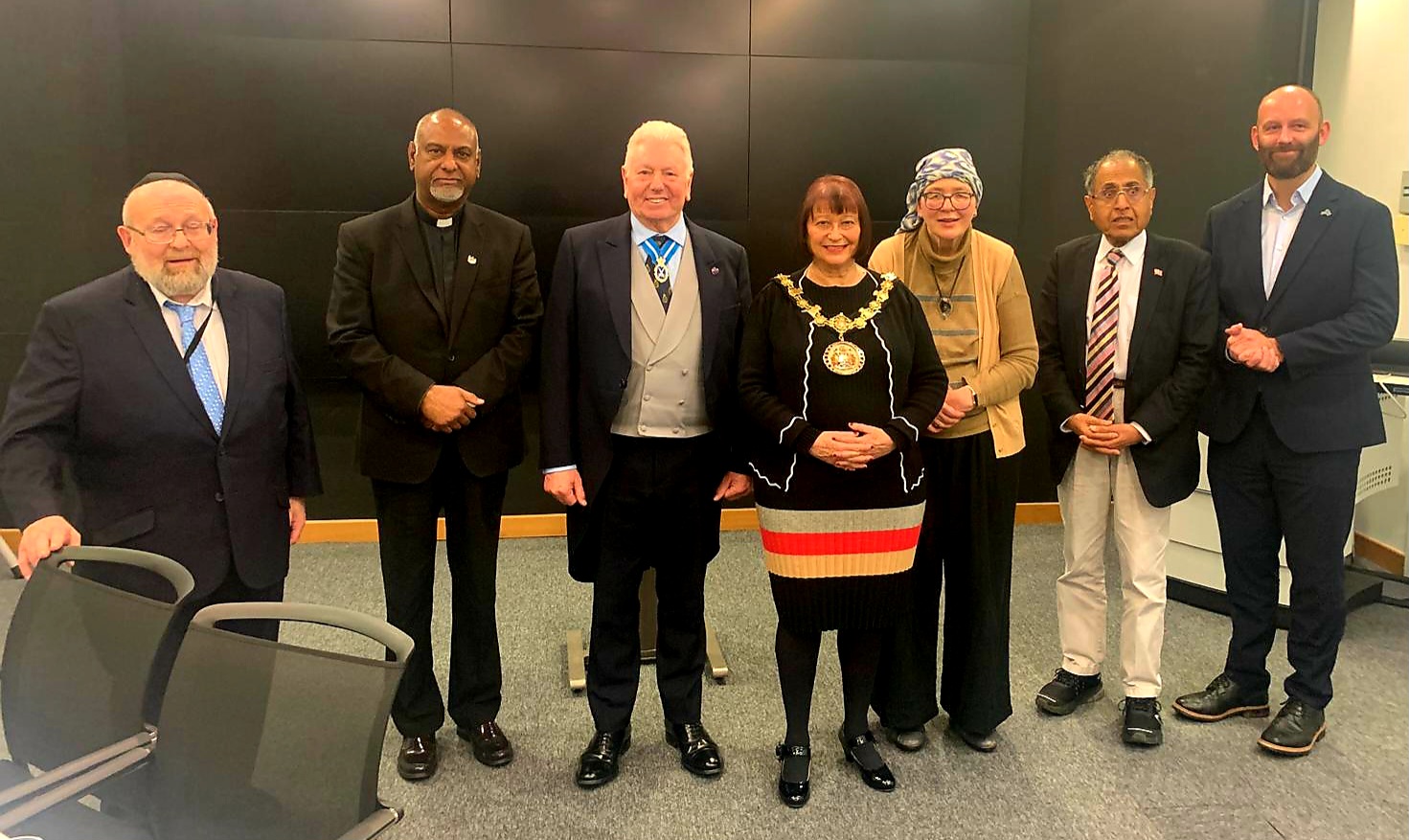
The photo below shows the speakers. From left to right:
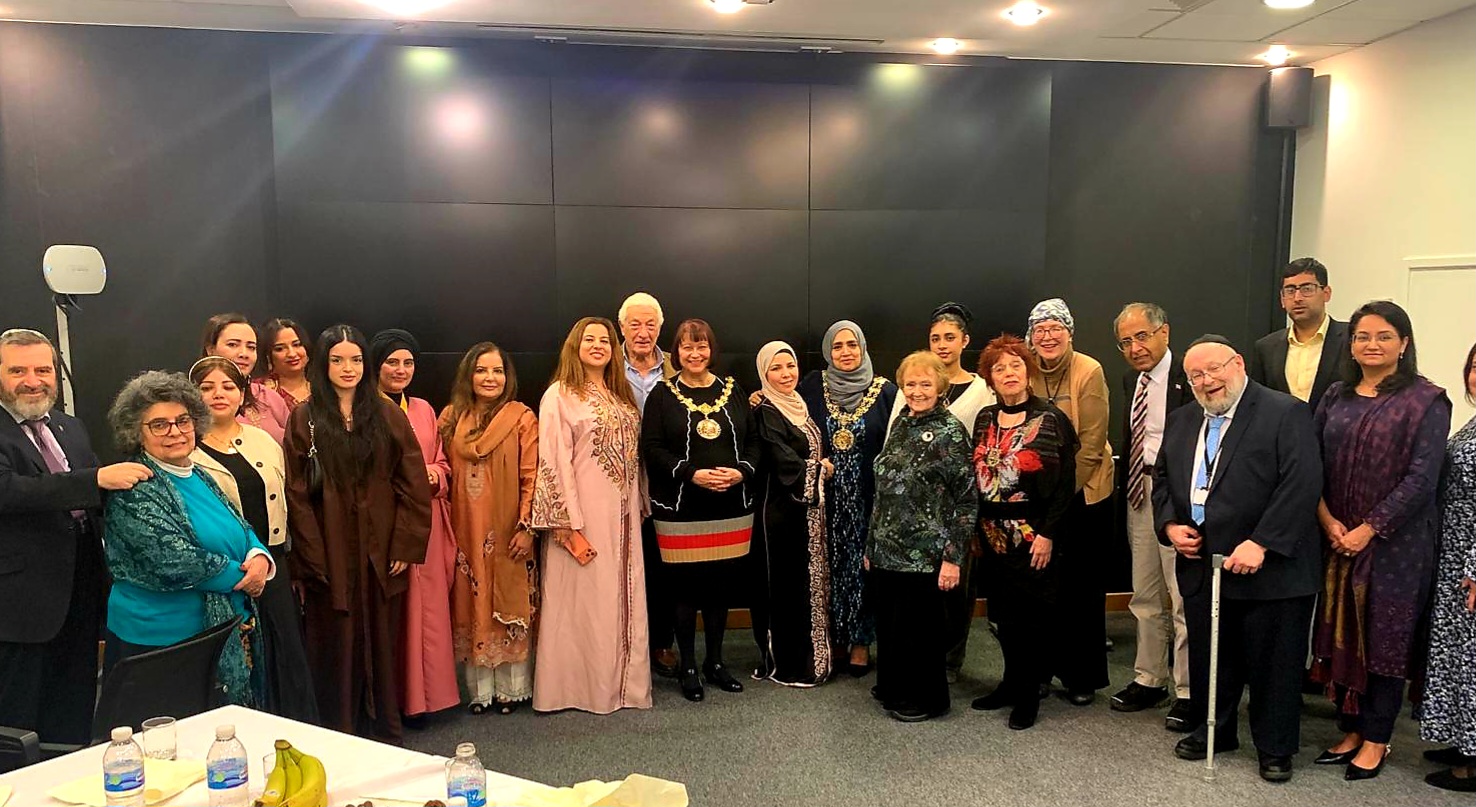
The group photo below shows some of the guests.
Follow @MJF_Manchester
The Muslim Jewish Forum of Greater Manchester
Established to develop the cultural and social ties between the Muslim and Jewish Communities of Greater Manchester